Exported PNGs, the flat deliverables
These are the production exports of the figures below. Click any one to open it full size.
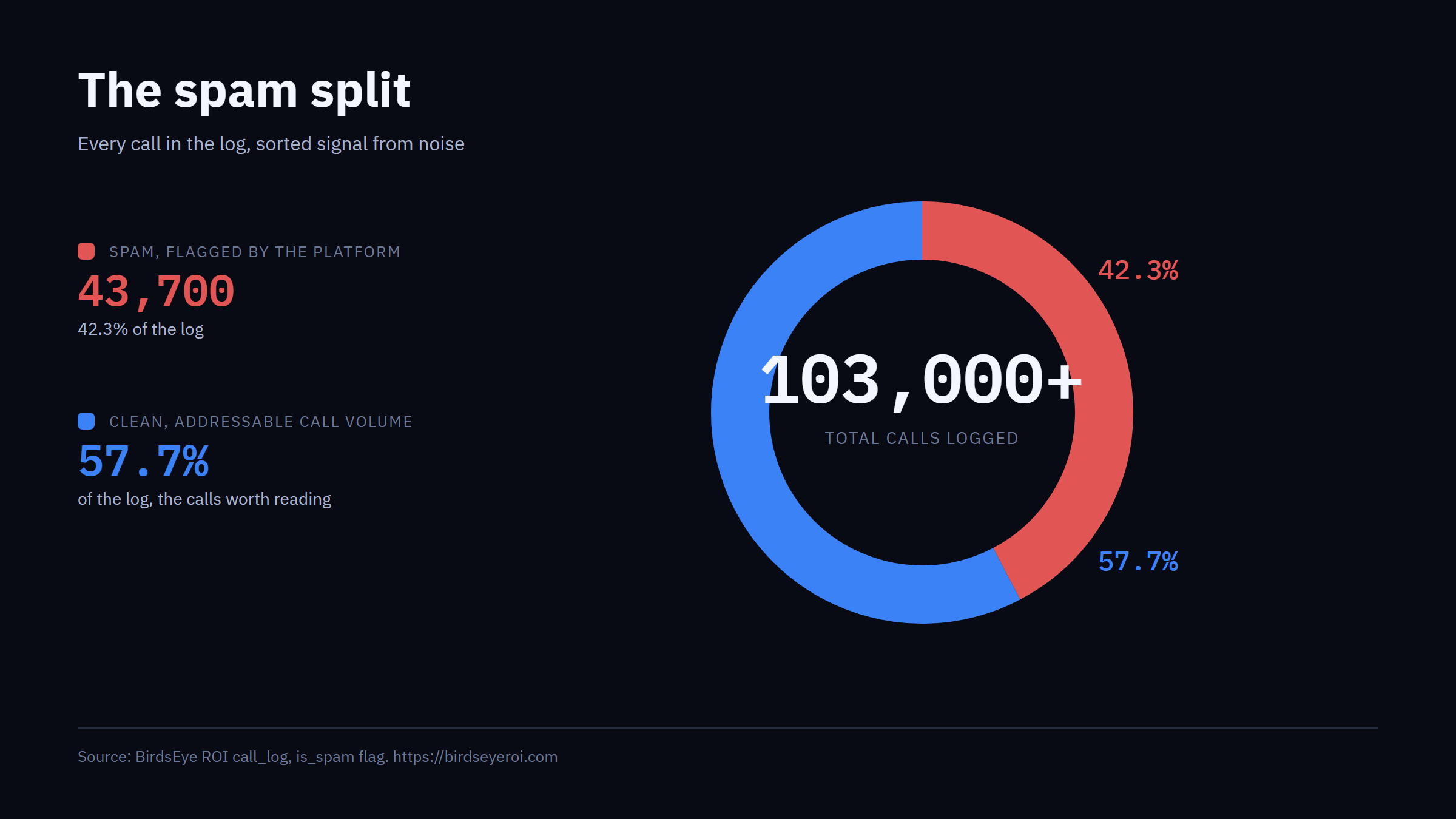 the spam split
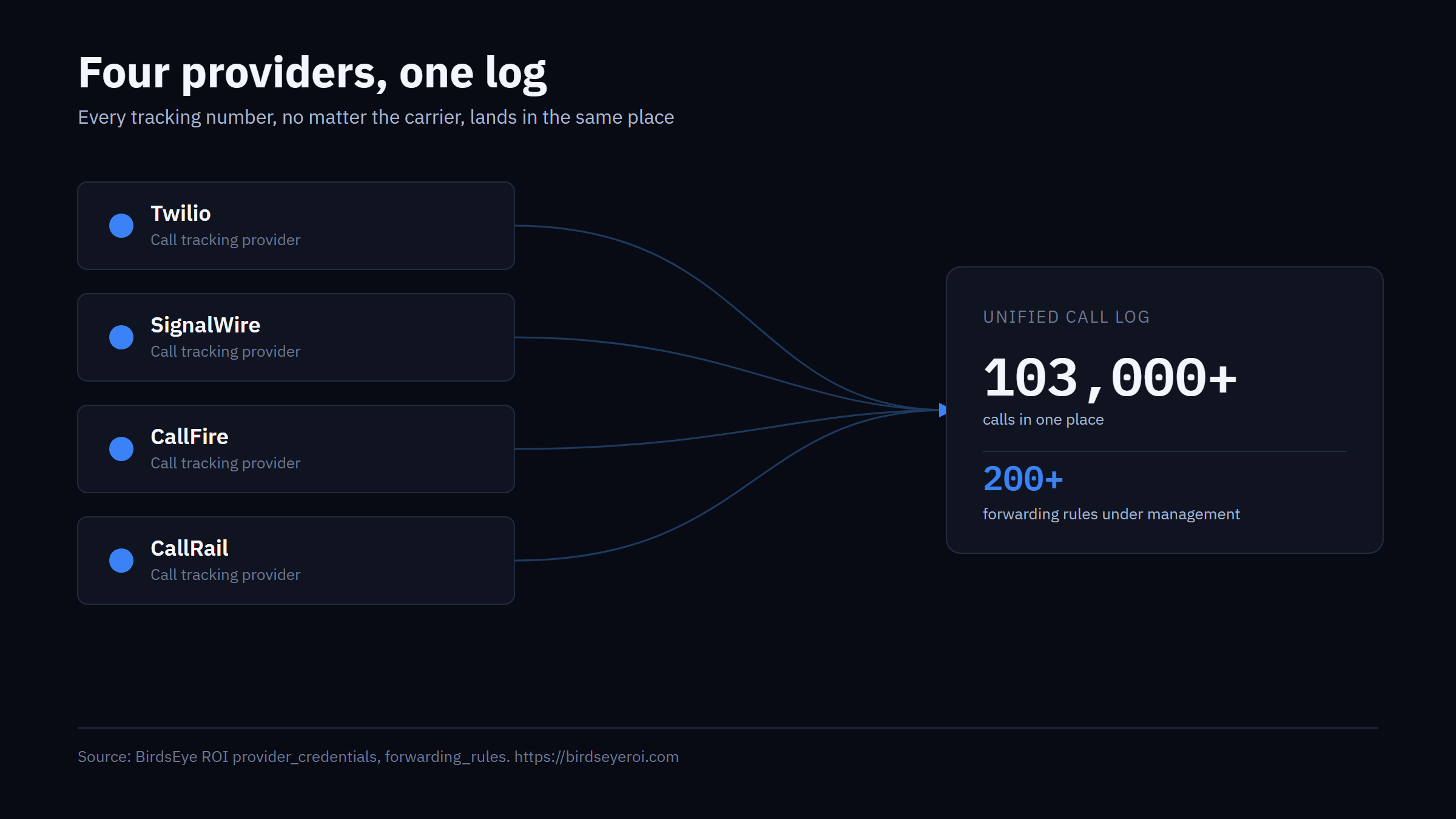 the four provider unification diagram
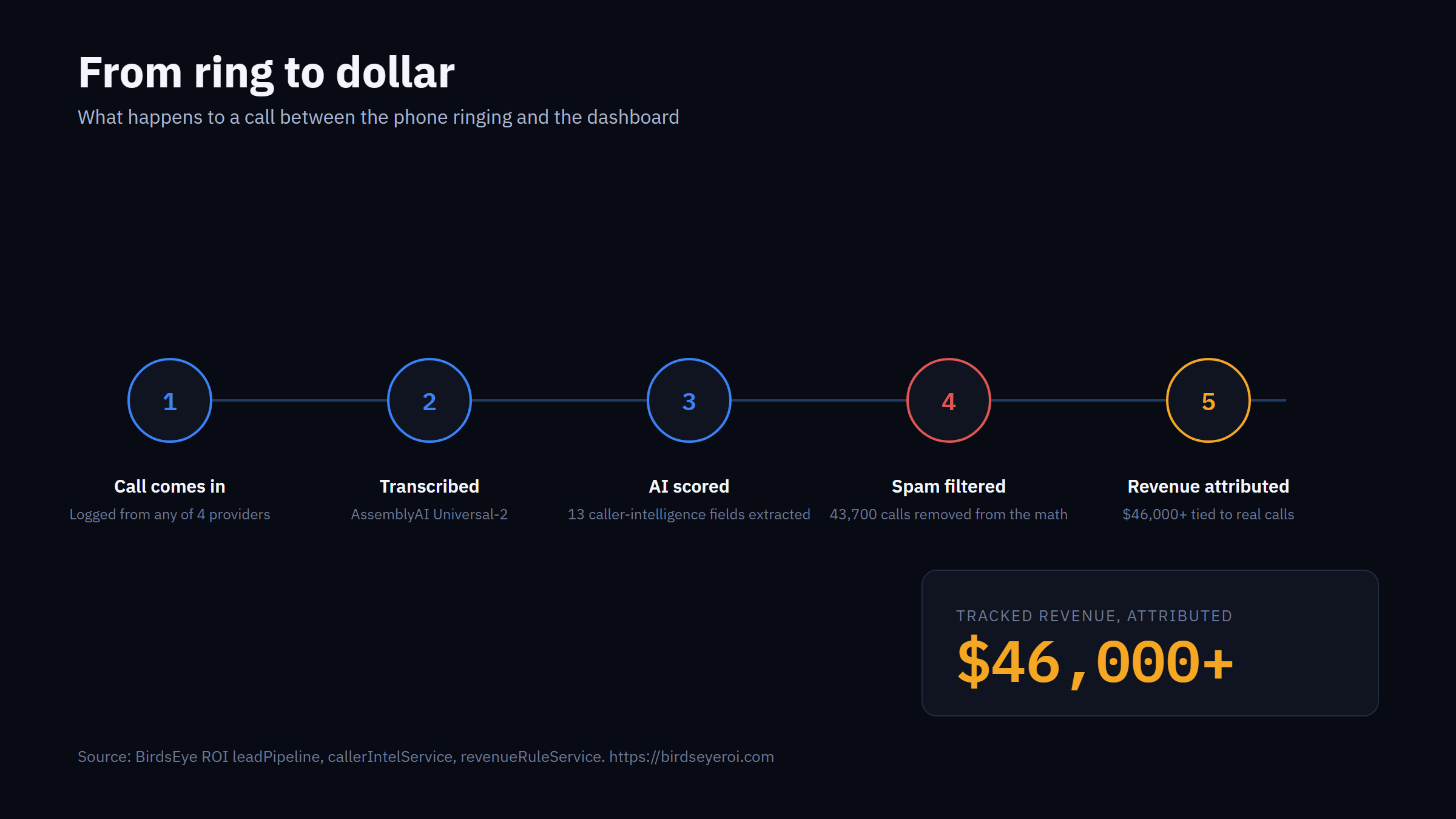 the call to revenue attribution pipeline
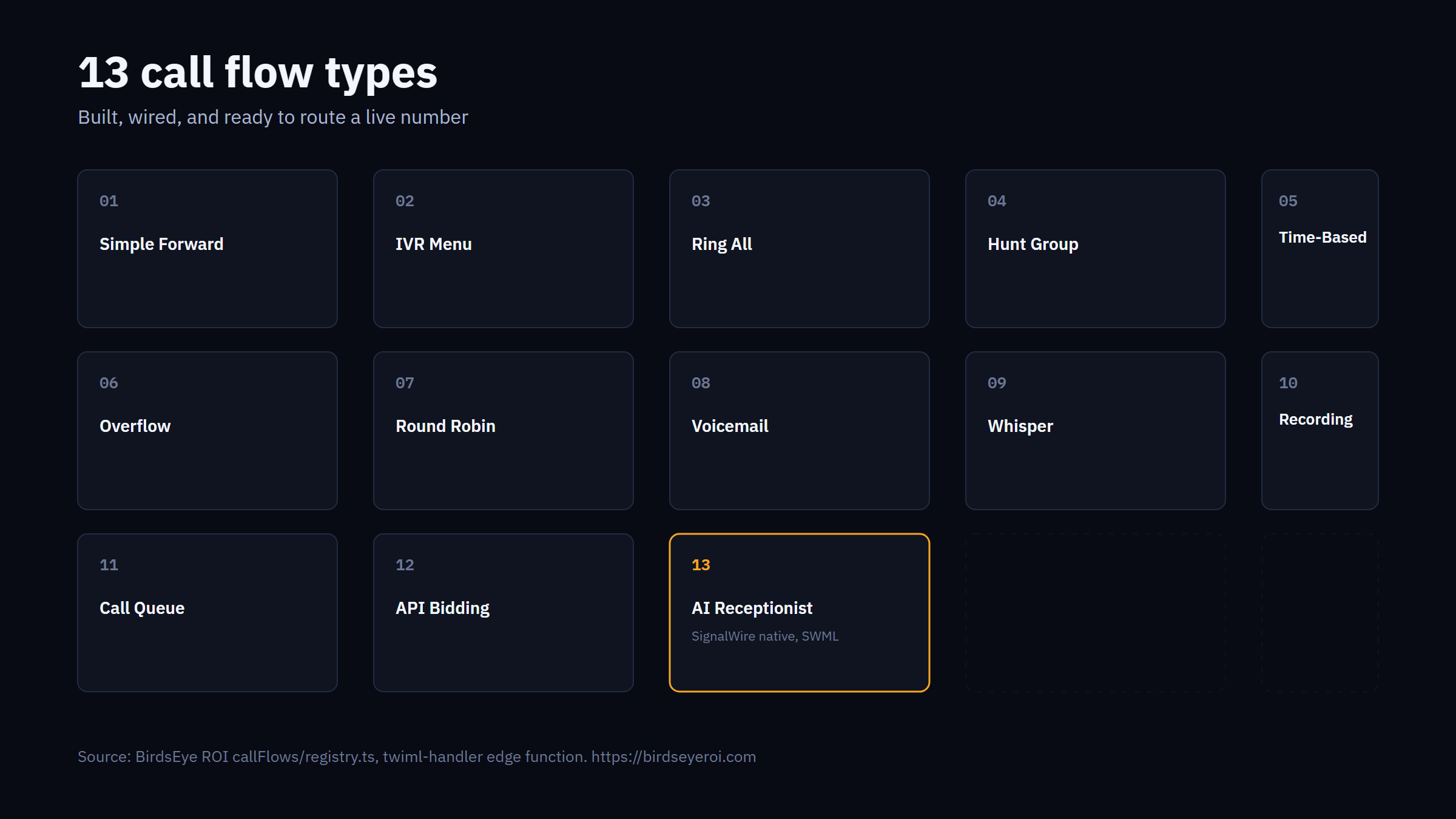 the 13 call flow types
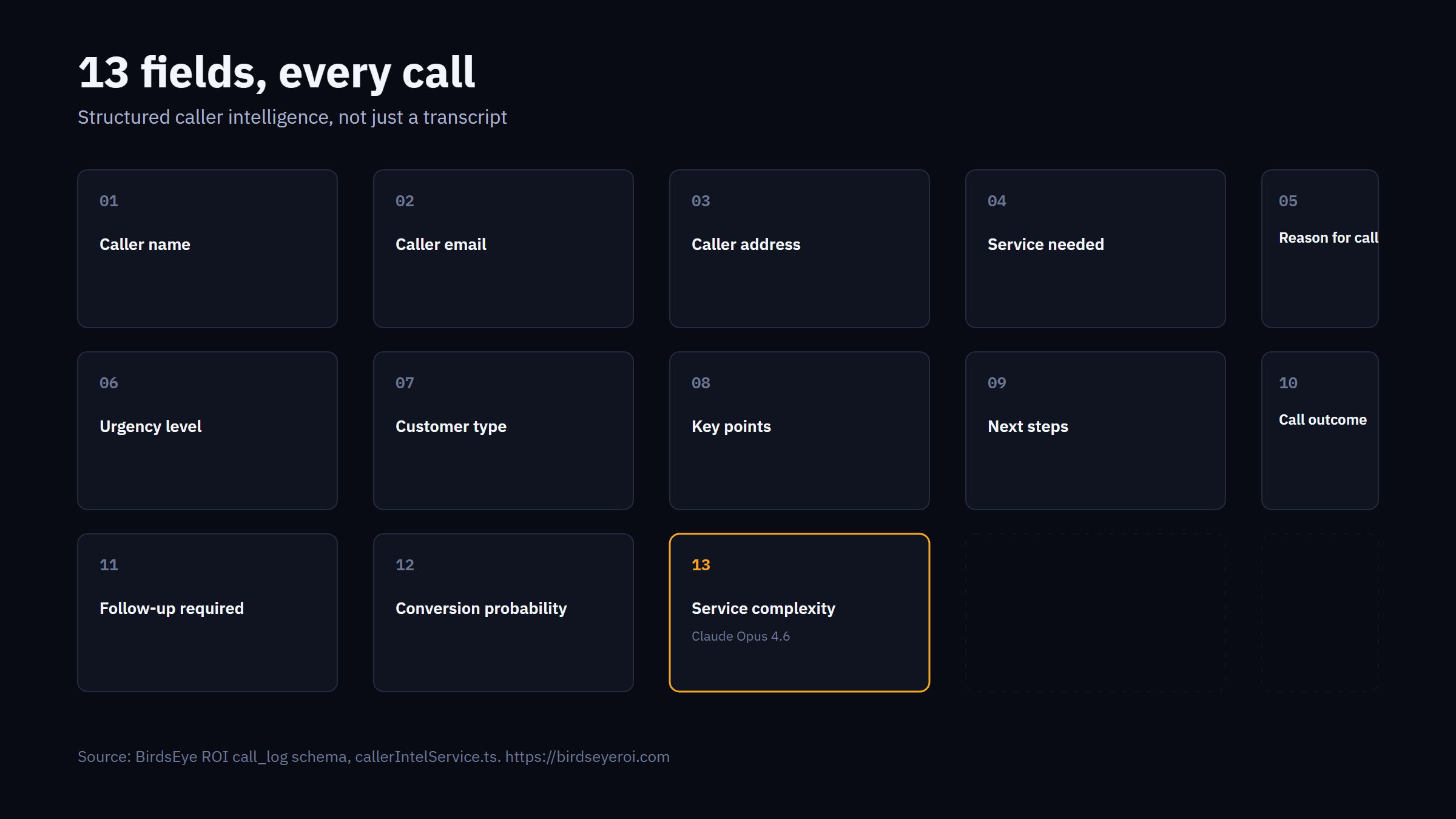 the 13 ai caller intelligence fields
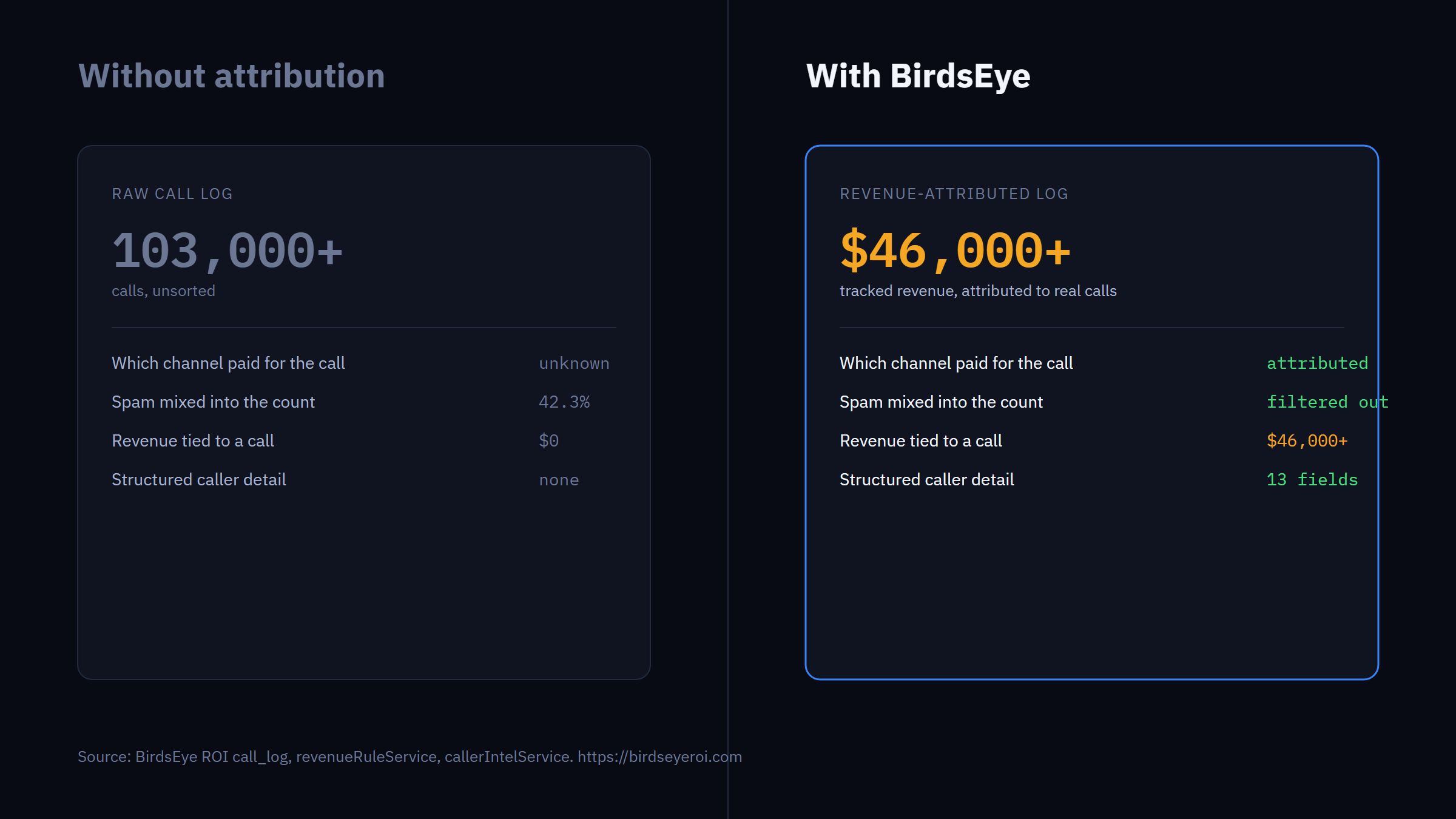 before after what the operator sees
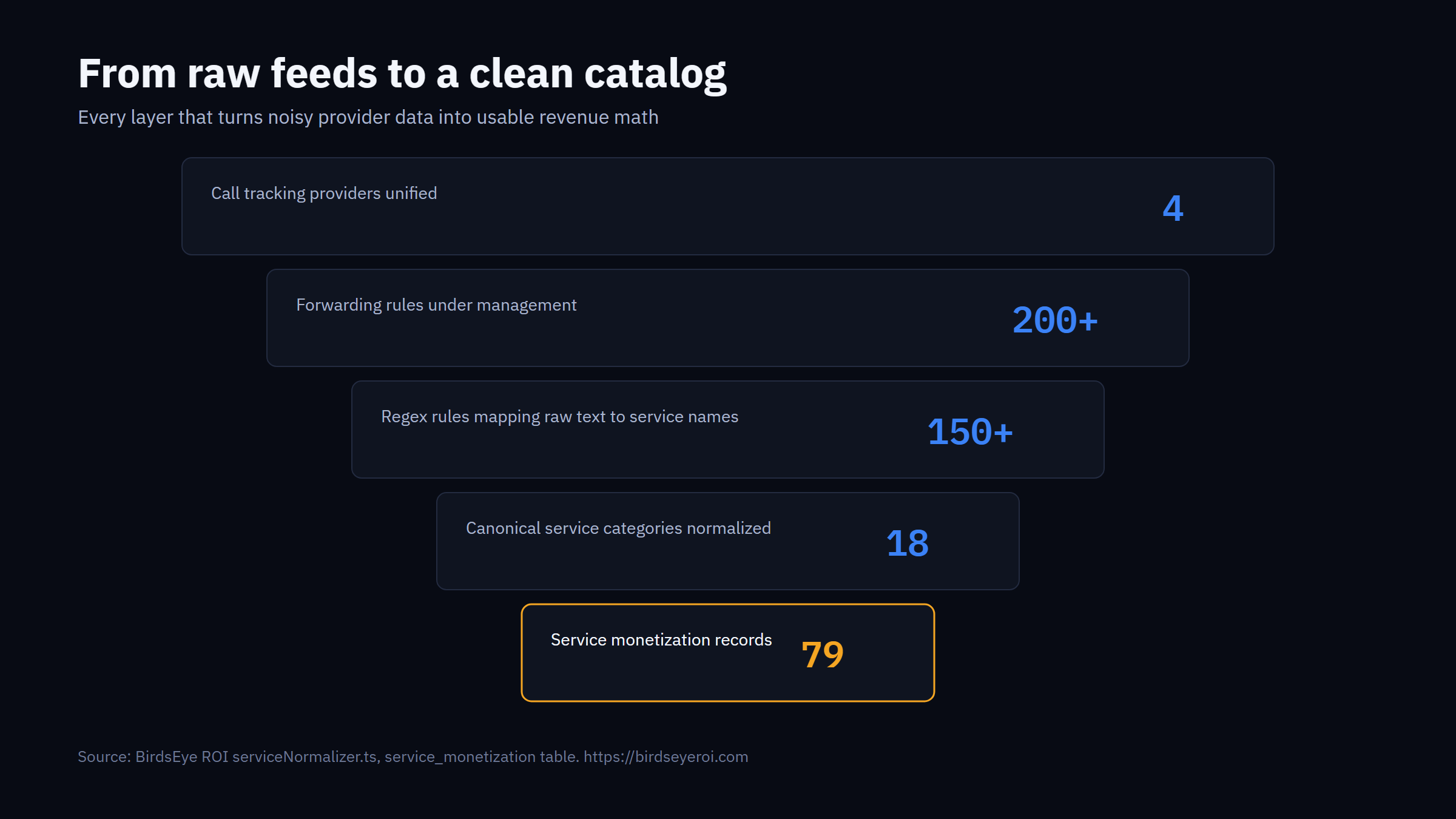 the unification funnel
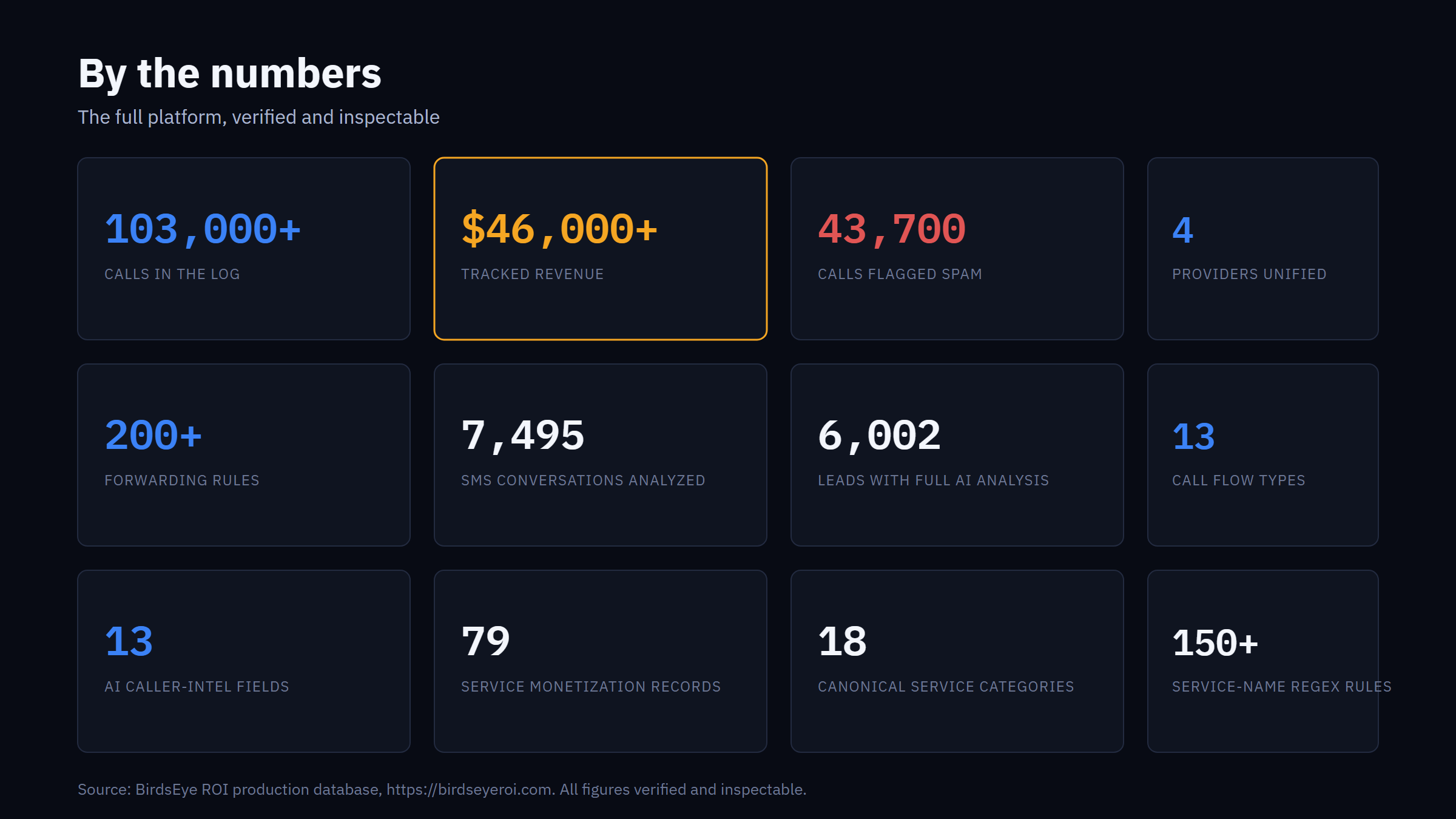 the platform scoreboard
BirdsEye ROI, Infographic Specifications
Eight production-ready infographics for the marketing kit. Every figure is
sourced from FACTS.md. Every color, type step, spacing value, and radius
below is pulled from visual-system.md, tokens are inlined as raw hex because
SVG delivered standalone cannot reliably resolve external CSS custom
properties, each hex is commented with its token name so it stays traceable.
All eight are built as self-contained viewBox="0 0 1200 675" SVG (or SVG
plus a thin CSS wrapper where noted). Because they are vector and scaled with
width: 100%; height: auto;, they degrade cleanly from 1200px down to 380px:
strokes, radii, and type all scale together. Where a graphic is dense enough
that 380px would crush the smallest caption, that graphic also ships a
data-compact variant note telling the builder which text to drop first.
No stock photography. No flat color-slab hero backgrounds. No dark scrims. No sparklines anywhere. Every mark carries a printed numeral.
1. The Spam Split
Title: "Nearly half the log is noise"
Exact data rendered: 103,000+ total calls logged. 43,700 calls flagged as spam by the platform (42.3% of the log). Remaining 57.7% is clean, addressable call volume (100% - 42.3%, arithmetic on the two stated facts, not a new figure).
Form: Full-size labeled donut, not a sparkline, not a pie without labels.
Two segments only: spam (--noise-red) and clean (--brand-sky). Center of
the donut carries the single hero figure. Each segment has its own printed
percentage and count directly on the ring, plus a two-item legend below with
the same numbers restated in Plex Mono.
Layout: 1200x675 canvas, dark surface (--surface-0). Title top-left at
H1. Donut centered-right at roughly 60% width, 380px diameter. Left column
carries the two legend rows stacked, each row is a color chip, a label in
Plex Sans Caption, and a value in Plex Mono Data L. Footer strip across the
bottom carries the source line in Caption/--ink-tertiary.
2. The Four-Provider Unification Diagram
Title: "Four providers, one log"
Exact data rendered: Twilio, SignalWire, CallFire, CallRail (4 call tracking providers unified), converging into one unified call log of 103,000+ calls governed by 200+ forwarding rules.
Form: Convergence diagram, not a chart. Four source nodes at left, connector lines bending into a single destination node at right.
Layout: 1200x675. Four provider node cards stacked vertically on the left
third, each --radius-md, --surface-1 fill, --surface-border stroke.
Each connector is a 1.5px path in --brand-sky-dim curving to a single
right-hand node. Destination node is the largest element on the canvas,
elevation-2, holds the two hero figures.
3. The Call-to-Revenue Attribution Pipeline
Title: "From ring to dollar"
Exact data rendered: the mechanism, stated in the capability list: unify, transcribe (AssemblyAI Universal-2), score (Claude Opus 4.6), filter spam (43,700 flagged), apply revenue rules, attribute revenue ($46,000+ tracked).
Form: Horizontal flow diagram, five stages, left to right, each stage a
node with an icon-mark and a one-line label. A single connective line runs
the full width beneath the nodes, the spam-filter stage is the only stage
drawn in --noise-red to show where noise exits the pipeline. The revenue
stage is the only stage drawn in --signal-amber to show where the dollar
figure lands.
Layout: 1200x675, five equal-width columns starting at x=64, each 214px wide with 30px gutters.
4. The 13 Call Flow Types
Title: "Every way a call can be routed, built and wired"
Exact data rendered: 13 call flow types built and wired, named exactly: Simple Forward, IVR Menu, Ring All, Hunt Group, Time-Based, Overflow, Round Robin, Voicemail, Whisper, Recording, Call Queue, API Bidding, AI Receptionist.
Form: Organized grid, not a list. 5 columns x 3 rows, 13 filled cells, 2 empty cells at the end left visibly empty (not stretched) to keep the grid honest about the count.
Layout: 1200x675, grid starts y=140, each cell 214px wide x 130px tall, 30px gutter.
5. The 13 AI Caller-Intelligence Fields
Title: "What the AI pulls out of every call"
Exact data rendered: the 13 dedicated AI caller-intelligence fields extracted per call, named exactly per the product's own call_log schema: caller_name, caller_email, caller_address, service_needed, reason_for_call, urgency_level, customer_type, key_points, next_steps, call_outcome, follow_up_required, conversion_probability, service_complexity.
Form: Organized grid identical structure to spec 4, so the two "13" graphics read as a matched pair in the kit. 5 columns x 3 rows, 13 filled, 2 empty.
Layout: same grid geometry as spec 4.
6. Before / After: What the Operator Sees
Title: "Same calls, two views"
Exact data rendered: without attribution, the operator has 103,000+ raw calls with no revenue tie and 42.3% of it is spam noise. With attribution, the operator sees $46,000+ tracked revenue, spam already filtered, and 13 fields of structured intelligence per call.
Form: Side-by-side split panel comparison, left labeled "Without BirdsyE" in muted tone, right labeled "With BirdsEye" in full-color tone. Not a screenshot mockup, a labeled contrast diagram, so it stays inside the no-stock-photo, hand-authored-markup constraint.
Layout: 1200x675, vertical divider at x=600, left half desaturated
(--ink-tertiary heavy), right half full palette.
7. The Unification Funnel
Title: "From four raw feeds to one clean service catalog"
Exact data rendered: 4 providers unified, 200+ forwarding rules, 150+ regex rules mapping raw AI text to canonical service names, 18 canonical service categories normalized, 79 service monetization records.
Form: Vertical funnel, each stage narrower than the last, five bands stacked top to bottom, each carrying its own number.
Layout: 1200x675, funnel bands centered horizontally, widths taper from 900px to 340px across five bands.
8. The Platform Scoreboard
Title: "BirdsEye ROI, by the numbers"
Exact data rendered: every verified platform number in the fact sheet: 103,000+ calls, $46,000+ revenue, 43,700 spam flagged, 4 providers unified, 200+ forwarding rules, 7,495 SMS conversations, 6,002 leads with full AI analysis, 13 call flow types, 13 caller-intelligence fields, 79 service monetization records, 18 canonical categories, 150+ regex rules.
Form: Dense KPI grid, financial-terminal style, 4 columns x 3 rows, 12 cells, each a self-contained stat tile per the "how a data figure is displayed" rule (value, unit label, nothing else).
Layout: 1200x675, grid starts y=130, each cell 274px wide x 150px tall, 20px gutter.
Build notes for whoever implements these
- Paste each
<svg>...</svg>block directly into the marketing HTML. No build step, no chart library import, no external font loading beyond linking IBM Plex Sans and IBM Plex Mono from Google Fonts (or self-hosting them) pervisual-system.mdsection 2. - At 380px, the grid-based graphics (4, 5, 8) keep their column count, since the SVG scales as one vector unit, text does not reflow. If a specific placement needs literal DOM reflow at small viewports instead of vector scaling, wrap the grid cells in a responsive HTML/CSS grid using the same token values instead of raw SVG, and rebuild cell content as absolutely positioned divs, the numbers and colors above still apply unchanged. Compact-variant guidance if this route is taken: drop item captions ("SignalWire native, SWML" on flow-type 13, "Claude Opus 4.6" on field 13) first, they are the lowest-priority text on the canvas.
- Every
<title>and<desc>pair is already written into each SVG for screen-reader accessibility, do not strip them. - Color usage audit before shipping: amber only touches revenue/conversion figures, red only touches the spam figure, blue is everything structural. If a future edit adds a number, follow that same rule before picking its color.